

By Skip Reid | Oct 15, 2026
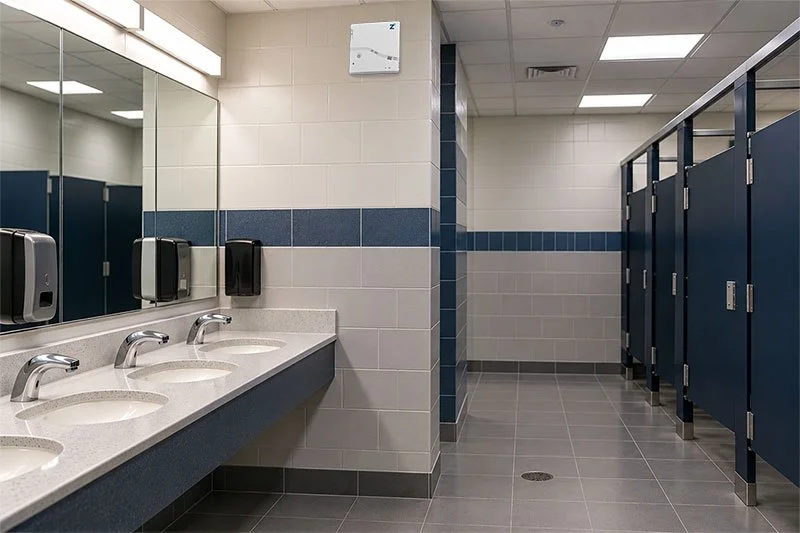
A middle/high school in Massachusetts's North Shore region was struggling with students vaping in bathrooms. Beyond the vaping itself, each suspected incident triggered investigations, extra patrols, disciplinary meetings, parent communication, and paperwork. The real cost wasn't dollars but the time of educators and administrators.
The Challenge
Vapor dissipates quickly, so regular smoke detectors don't work well. Bathrooms are private spaces where constant staff supervision isn't practical, leaving the school to rely on reports, patrols, and reactive investigations. Each incident pulls teachers, administrators, and counselors away from other work, and that time adds up over a school year.
The Solution
Dugmore & Duncan worked with a trusted systems integrator to install eight wired Zeptive vape detectors in the first-floor bathrooms and six in the second-floor bathrooms. Two existing wireless battery-powered detectors on the first floor were also wired into the network. The detectors run on Power over Ethernet (PoE), which delivers power and network connectivity through a single cable. Each detector uses one PoE switch port and has its own IP address, so all of them can be centrally monitored as part of the school’s security infrastructure. When a suspected vaping event occurs, designated staff receive an alert showing the location, reducing the need for constant patrols.
Why It Counts as Security
Modern security goes beyond doors and locks. Access control governs who enters a space, and networked sensors add visibility into what's happening inside the building. Connecting vape detectors to the existing network adds another layer of awareness.
The Hidden Cost: Time
When evaluating detection systems, the better question isn't just what the equipment costs, but what the current approach already costs the school in patrols, investigations, meetings, and documentation. The goal isn't to catch more students. It's to create a more informed, consistent, and efficient response with less disruption.
Results
Staff can now identify and respond to suspected incidents more efficiently, and centralized monitoring gives better visibility across protected areas. Technology won't eliminate youth vaping or replace education, prevention, counseling, and clear policies, but combined with those it can reduce the time, uncertainty, and disruption vaping causes.
Takeaway
Effective school security isn't always about adding another lock or door. Sometimes it means finding technology that fits into existing infrastructure. For this school, networked vape detection helps staff monitor hard-to-supervise areas and protect time, freeing educators to focus on helping students learn and thrive.
Looking to modernize your facility's security? Contact Dugmore & Duncan to discuss an access control solution designed around your building, your users, and your long-term security goals.