

Do You Know Where Your Keys Are?
By Chris Allen | May 12, 2026
Why Schools and Universities Need Stronger Key Control Systems
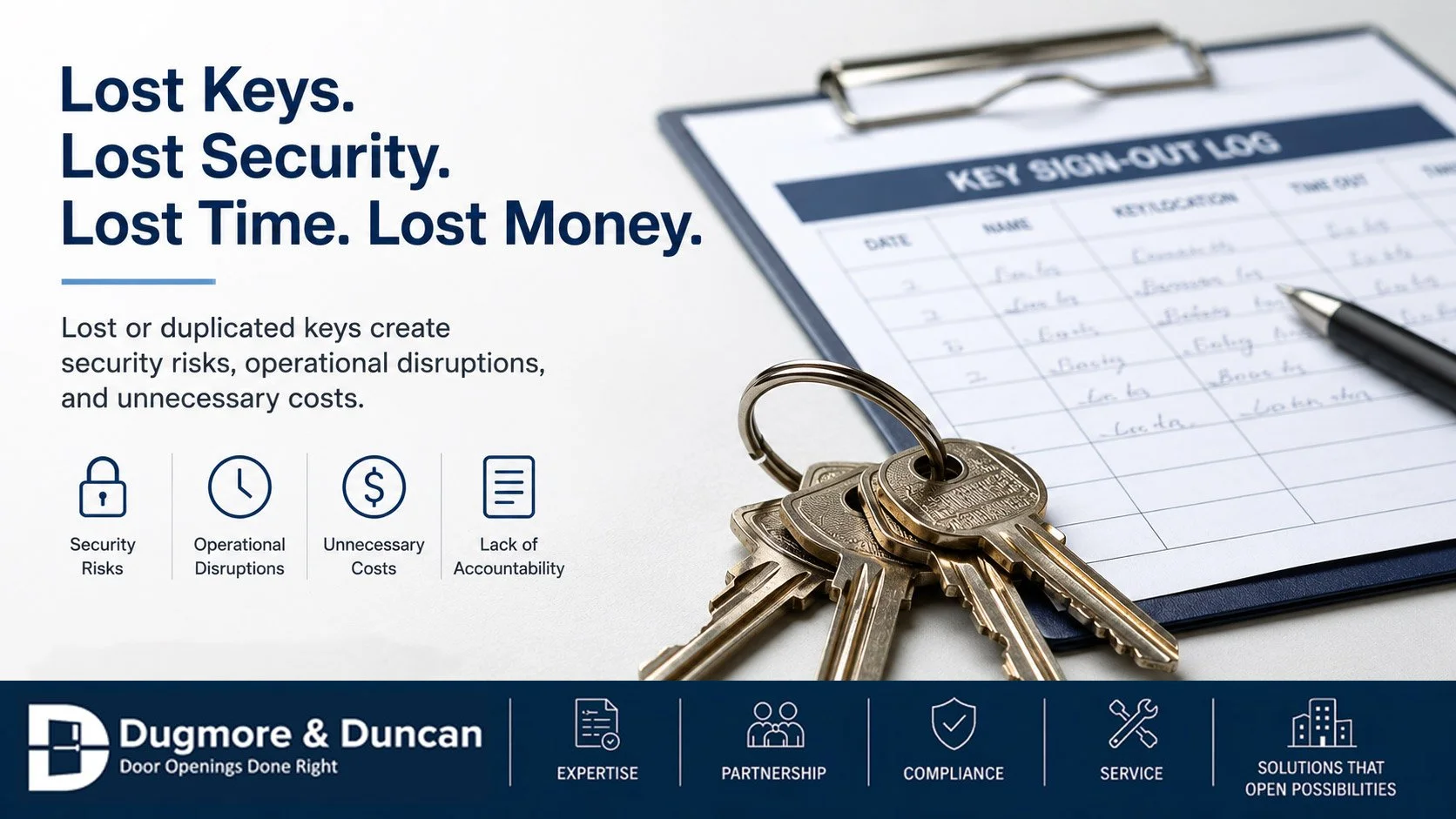
In educational environments, security is often discussed in terms of cameras, visitor management systems, lockdown procedures, and access control technology. Yet one of the most overlooked vulnerabilities on many campuses is still one of the oldest: physical keys.
From elementary schools to large university campuses, thousands of keys may exist across classrooms, maintenance rooms, IT closets, laboratories, athletic facilities, dormitories, and administrative offices. Without a structured key management program, lost, duplicated, or untracked keys can create significant financial, operational, and safety risks.
At Dugmore & Duncan, we work with educational facilities throughout New England to help organizations improve both physical security and operational accountability through professional door hardware, key systems, and access control solutions.
The Real Risk of Lost Keys in Schools
A lost key is rarely “just a lost key.”
In many educational facilities, a single misplaced key can compromise multiple doors or entire sections of a campus. The danger becomes exponentially greater when the missing key belongs to a top-level key, like master key.
Why Master Keys Are So Critical
A master key may provide access to all openings on a campus.
This creates serious concerns involving:
Student and staff safety
Unauthorized after-hours access
Theft and vandalism
Liability exposure
Compliance and insurance risks
Emergency response integrity
In many cases, a compromised master key may require:
Re-keying dozens or hundreds of cylinders
Reissuing keys to staff
Updating key records
Reconfiguring access permissions
Significant labor and hardware costs
For large campuses, the cost of re-keying after a master key loss can quickly escalate into thousands — or even tens of thousands — of dollars.
The Ongoing Problem of Unauthorized Key Duplication
Many facilities unknowingly operate with uncontrolled key duplication.
Without a patented or restricted keyway system, keys can often be copied at local hardware stores or kiosks without authorization. Over time, organizations lose visibility into how many copies exist and who possesses them.
In educational settings, this can become especially problematic due to:
Staff turnover
Contractors and temporary personnel
Student workers
Substitute teachers
Vendor access
Retired or transferred employees
Shared departmental keys
A campus may believe it has control of its keys when, in reality, duplicate copies may exist far beyond official records.
Best Practices for School Key Control Programs
Educational institutions should treat key management as part of their overall physical security strategy — not simply as a maintenance function.
1. Centralize Key Management
A centralized key control location helps establish accountability and consistency.
Best practices include:
Secured key cabinets or intelligent key management systems
Limited access to authorized personnel only
Clearly labeled and documented key inventory
Standardized sign-out procedures
Centralized oversight by facilities or security management
Centralization reduces the risk of keys being stored in desks, maintenance carts, or unsecured locations throughout campus buildings.
2. Limit Access Based on Role and Responsibility
Not every employee requires broad access.
A properly designed master key system should follow the principle of least privilege:
Teachers receive only the access needed for assigned classrooms
Custodial staff receive area-specific access
IT personnel access only technology spaces
Coaches access athletic facilities only
Vendors and contractors receive temporary or restricted access
Limiting access reduces overall exposure if a key is lost or duplicated.
3. Control Access by Schedule
Schools often have varying schedules involving:
Evening events
Athletics
Summer programs
Cleaning crews
Contractors
Weekend activities
Organizations should evaluate whether access is appropriate based on time and operational need.
In some cases, transitioning certain openings to electronic access control can allow administrators to:
Set schedules
Enable temporary credentials
Revoke access instantly
Track door activity
Eliminate risks associated with copied keys
4. Track Every Key Removal and Return
One of the most important improvements schools can make is implementing formal key tracking procedures.
A strong key control process should document:
Who removed the key
Date and time removed
Purpose of use
Date and time returned
Outstanding or overdue keys
Electronic key management systems can automate this process while providing audit trails and reporting capabilities.
This level of accountability is especially important during:
Staff transitions
Security incidents
Emergency investigations
Insurance claims
Compliance reviews
5. Use Restricted or Patented Key Systems
Restricted keyways help prevent unauthorized duplication.
With patented key systems:
Keys can only be duplicated through authorized providers
Duplication requires documented authorization
Key records are maintained and controlled
Organizations gain stronger long-term accountability
For educational facilities, restricted systems significantly reduce the risk of uncontrolled copies circulating outside the organization.
6. Establish Formal Key Policies
Technology alone is not enough. Schools should also implement written policies that define:
Who can authorize keys
Who can request duplicates
Key return procedures
Lost key reporting requirements
Employee accountability expectations
Consequences for policy violations
Clear policies improve consistency across departments and campuses.
7. Audit Your Existing Key System Regularly
Many schools operate legacy systems that have evolved over decades with little documentation or review.
Regular audits help identify:
Excessive master key distribution
Unreturned keys
Obsolete cylinders
Duplicate vulnerabilities
Inconsistent access levels
Areas requiring modernization
A professional key system evaluation can help organizations understand their current risk exposure and prioritize improvements.
The Financial Impact of Poor Key Control
While the security implications are significant, the operational costs are often equally damaging.
Poor key management can lead to:
Expensive campus re-keying projects
Lost staff productivity
Increased maintenance labor
Security investigations
Liability exposure
Insurance complications
Emergency response delays
For educational institutions operating under tight budgets, preventing these issues is far more cost-effective than reacting after an incident occurs.
Building a More Secure Educational Environment
Physical security in schools begins at the opening itself.
A properly managed key system helps educational organizations:
Improve accountability
Reduce unauthorized access
Protect students and staff
Simplify facility operations
Strengthen emergency preparedness
Reduce long-term security costs
As campuses continue balancing traditional mechanical hardware with modern electronic security solutions, structured key management remains a foundational component of any comprehensive security strategy.
Partner with Dugmore & Duncan
Dugmore & Duncan helps educational facilities evaluate and improve their:
Master key systems
Restricted key systems
Door hardware infrastructure
Access control integration
Key management procedures
Facility security planning
Whether your organization operates a single school or a multi-building campus, our team can help develop scalable solutions that improve both security and operational efficiency.
To learn more about campus key control solutions, contact Dugmore & Duncan for a facility evaluation or consultation.