

Key Deposit Box - Emergency Responder Access Systems
By Brian Lundgren | June 29, 2026
Why Rapid Building Entry Planning Matters
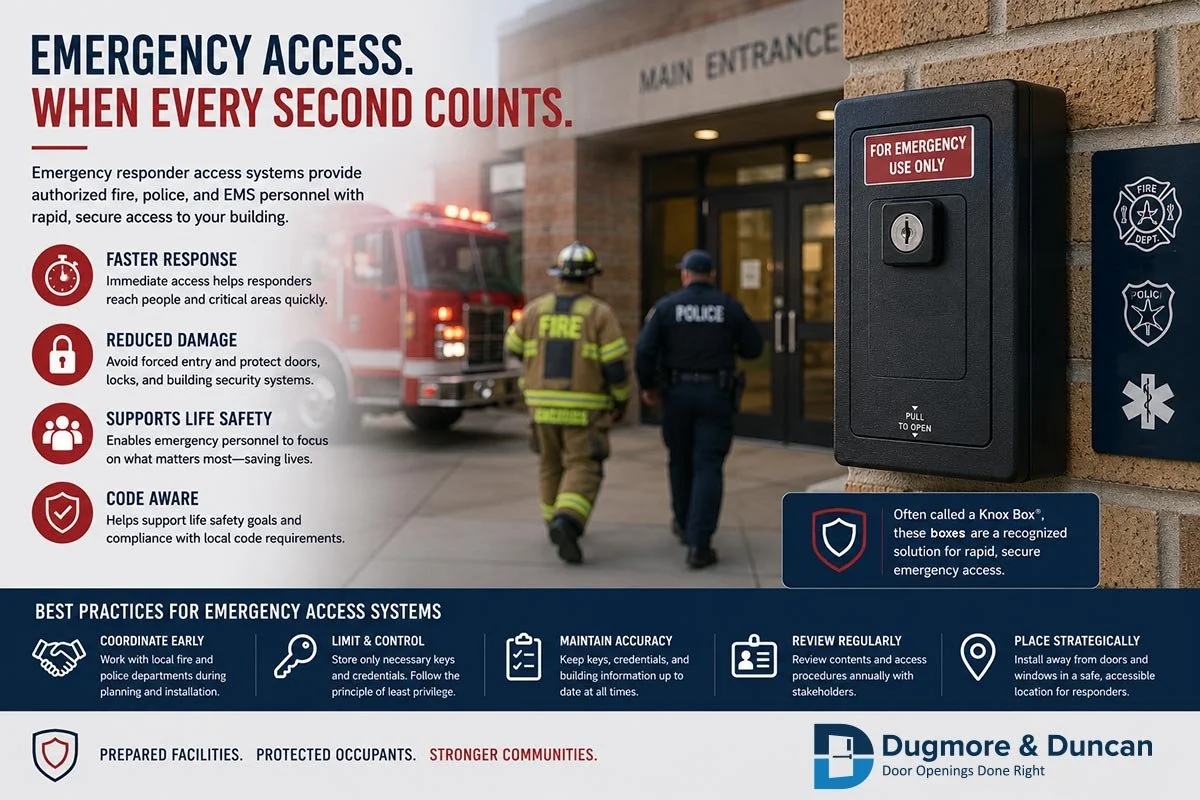
In educational facilities and other large commercial buildings, emergency response time matters. When police, fire departments, or emergency medical personnel arrive during a crisis, immediate access to the building can save lives, reduce property damage, and improve emergency coordination.
One of the most widely used tools supporting rapid emergency access is the key deposit box — commonly referred to by many as a Knox Box®, one of the most recognized brands in the industry.
While many facility managers focus heavily on electronic access control, credential management, and lockdown procedures, emergency responders still require a dependable and immediate method of entering a building during situations where time is critical.
At Dugmore & Duncan, we often help organizations coordinate emergency access strategies that balance:
Security
Life safety
Operational continuity
Emergency responder accessibility
Code compliance
A properly planned key deposit box emergency responder access system can play an important role in that strategy.
What Is a Key Deposit Box?
A key deposit box is a hardened, secure key vault installed on the exterior of a building. It allows authorized emergency personnel to gain access to master keys, access cards, floor plans, or other emergency response materials stored inside the vault.
These boxes are commonly known as:
Emergency key access systems
Rapid entry systems
Fire department access boxes
Emergency access boxes
“Knox Box®” is one of the most widely recognized examples of this type of system.
The box itself is secured with a specialized lock system controlled by local emergency services, typically:
Fire departments
Police departments
Emergency response agencies
Only authorized emergency personnel possess the keys or credentials needed to open the vault.
Once opened, responders can retrieve:
Building master keys
Electronic access credentials
Elevator keys
Fire alarm panel keys
Mechanical room keys
Gate keys
Emergency floor plans
This allows emergency personnel to quickly access secured areas without forcing entry into the building.
Why Emergency Responder Access Systems Are Important
Faster Emergency Response
During emergencies such as:
Fires
Active threats
Medical emergencies
Hazardous material incidents
Utility failures
Emergency responders may need immediate access to multiple areas of a facility.
Without emergency access systems, responders may be forced to:
Break doors
Damage locks
Force entry through windows
Wait for facility personnel to arrive
These delays can increase risk to occupants and responders alike.
Emergency responder access systems help reduce entry delays and allow responders to move more efficiently throughout the building.
Reduced Property Damage
Forced entry often causes significant damage to:
Doors
Frames
Locks
Glass
Access control hardware
A properly managed rapid entry system allows responders to enter securely without unnecessary destruction to building openings and security infrastructure.
Support for Large and Complex Facilities
Educational campuses, healthcare facilities, and large commercial properties often contain:
Multiple entrances
Secured interior spaces
Lockdown areas
Mechanical and electrical rooms
Access-controlled corridors
Emergency responders cannot afford to waste valuable time determining which doors provide access to critical areas.
Emergency responder access systems help simplify building access during high-pressure situations.
Common Use
Emergency responder access systems are especially common in:
K-12 schools
Colleges and universities
Municipal buildings
Healthcare facilities
Industrial sites
Educational facilities present unique challenges because they often combine:
Controlled visitor access
Classroom security
Lockdown procedures
Large occupant populations
Multiple building wings
Athletic facilities
After-hours activities
Emergency responders may need rapid access to:
Main corridors
Administrative offices
Stairwells
Mechanical rooms
Gymnasiums
Classrooms
Exterior gates
Elevators
Roof Access
Fire Escapes
For this reason, emergency access planning is often incorporated into broader school safety and emergency preparedness programs.
Placement Matters
A key deposit box should never simply be mounted wherever space is available.
Proper placement is extremely important for both:
Emergency responder safety
Security effectiveness
In many cases, it is recommended to mount the access box:
Away from primary doorways
Away from large windows
In visible but controlled locations
In areas that reduce responder exposure during emergencies
For example, mounting the box directly beside a main entrance could expose emergency personnel to unnecessary danger during violent incidents or active threat situations.
Instead, placement may be better suited:
In locations coordinated with local police and fire departments
Along the side of a building
Near a protected approach path
Adjacent to emergency responder staging areas
The exact placement strategy should always be coordinated with:
Authorities Having Jurisdiction (AHJs)
Local fire officials
Security consultants
Facility management
Life Safety Codes and Local Regulations
One of the most important considerations when planning an emergency responder access system is understanding that requirements vary by jurisdiction.
Different states, municipalities, and fire departments may enforce different versions of:
International Fire Code (IFC)
NFPA standards
State fire codes
Local amendments
School safety regulations
Some jurisdictions may:
Require key deposit boxes
Specify mounting heights
Define approved locations
Require specific contents
Mandate annual inspections
Control keying procedures
Others may have entirely different emergency access procedures.
Because code adoption varies significantly by region, facility managers should always verify requirements with local Authorities Having Jurisdiction before installation.
Best Practices for Emergency Access Planning
Coordinate With Emergency Responders Early
Police and fire departments should be involved early in the planning process to ensure the emergency access strategy aligns with local response procedures.
Limit Stored Keys to Necessary Access Only
Keys stored inside the emergency access box should follow the principle of least privilege while still supporting emergency response needs.
Maintain Accurate Key Control
Stored keys should be documented, tracked, and updated whenever:
Locks are rekeyed
Access levels change
Renovations occur
Security systems are upgraded
Include Access Control Credentials When Appropriate
Some facilities include:
Access cards
Fobs
Electronic credentials
to support electronic access control systems during emergencies.
Review Emergency Access Annually
Emergency access strategies should be reviewed regularly with:
Facility management
Security teams
Local responders
to ensure systems remain aligned with current building conditions and operational procedures.
Security and Life Safety Must Work Together
Modern facilities must balance two priorities:
Restrict unauthorized access
Enable rapid emergency response
Emergency responder access systems help bridge that gap by providing controlled emergency access while preserving overall building security.
At Dugmore & Duncan, we believe emergency access planning should never be treated as an afterthought. Mechanical key systems, electronic access control, lockdown procedures, and emergency responder coordination must all work together as part of a comprehensive life safety and security strategy.
When properly implemented and coordinated with local code requirements, emergency responder access systems can help facilities improve emergency preparedness while reducing operational risk and property damage.