

Why Key Override Still Matters in Modern Electronic Access Control Systems
By Brian Lundgren | July 20, 2026
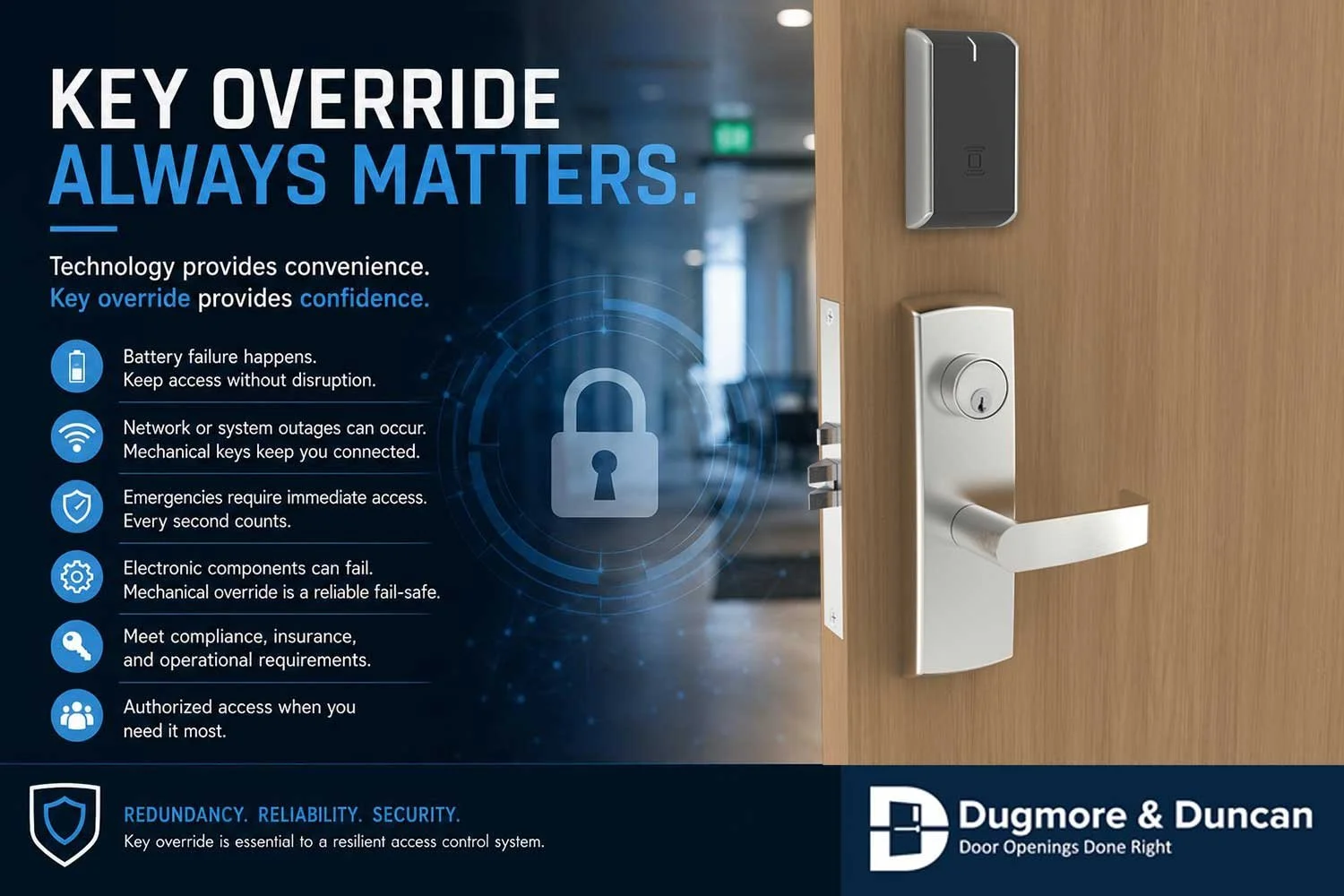
Technology provides convenience. Key override provides confidence.
As electronic access control systems continue to evolve, many facility managers assume that physical keys are becoming obsolete. Cloud-based management, wireless locks, mobile credentials, PIN codes, and integrated security platforms have transformed how buildings are secured and managed.
Despite these advancements, one requirement consistently remains at the top of nearly every specification and customer request: mechanical key override capability.
Whether a lock is battery-operated, wireless, hardwired, or fully integrated into an enterprise access control platform, Dugmore & Duncan almost always recommends including a key override cylinder. While electronic credentials may control day-to-day access, the mechanical key remains one of the most important layers of redundancy and emergency preparedness in a secure opening.
What Is Key Override?
Key override is a mechanical cylinder built into an electronic lock that allows authorized personnel to unlock the door using a physical key, even if the electronic system is unavailable or inaccessible.
This applies to:
Stand-alone electronic locks
Wireless access control locks
Hardwired online systems
Integrated smart lock platforms
Battery-operated cylindrical and mortise locks
Wireless cabinet and server room locks
Perimeter and interior electronic openings
In simple terms, the electronic system manages convenience and automation, while the key override provides a dependable backup method of entry.
Why Key Override Is Still Critical
1. Battery Failure Happens
Battery-operated locks are extremely reliable, but no battery lasts forever.
Most modern electronic locks provide low-battery warnings and system notifications, but facilities are complex environments. Batteries can be overlooked, maintenance schedules can slip, or devices can fail unexpectedly.
Without key override, a depleted battery could create:
Lockouts
Delayed access
Emergency response issues
Service interruptions
Expensive emergency service calls
A properly managed mechanical override key immediately restores access without requiring destructive entry or immediate lock replacement.
2. Network or System Outages Can Occur
Wireless and cloud-connected access control systems rely on:
Network infrastructure
Controllers
Gateways
Wireless communication
Software platforms
Power availability
Even highly redundant systems can experience:
Communication failures
Power outages
Server interruptions
Software issues
Cybersecurity incidents
In these situations, electronic credentials may not function as expected. Mechanical override ensures that authorized personnel can still gain entry to critical spaces.
For many organizations, this is a business continuity requirement rather than simply a convenience feature.
3. Emergency Access Must Be Immediate
During emergencies, speed matters.
Security directors, facility managers, maintenance personnel, and first responders often need immediate access to:
Mechanical rooms
Electrical rooms
IT spaces
Stairwells
Lockdown areas
Utility spaces
Perimeter doors
Electronic systems can become complicated during emergency situations. Credentials may not be available, personnel may not have proper permissions, or systems may intentionally lock down openings during a security event.
A mechanical override provides a direct and dependable method of entry when time is critical.
4. Electronic Components Can Fail
Like any technology, electronic locks contain components that can eventually fail:
Circuit boards
Readers
Solenoids
Motors
Wireless modules
Sensors
Environmental conditions can accelerate these failures if not properly maintained:
Moisture
Temperature swings
Dust
Vibration
Corrosion
Heavy usage cycles
Key override acts as a fail-safe layer that allows facilities to continue operating while repairs are scheduled.
5. Many Facilities Still Require Mechanical Redundancy
In many industries, mechanical override is not optional — it is expected.
Organizations often maintain strict operational policies requiring physical key access for:
Life safety compliance
Risk management
Insurance requirements
Emergency preparedness
Critical infrastructure protection
Multi-building master key systems
This is especially common in:
Educational facilities
Healthcare campuses
Government buildings
Manufacturing plants
Commercial real estate
Utilities and infrastructure sites
Even highly advanced electronic access control environments typically maintain some form of mechanical key hierarchy.
6. Key Override Supports Phased Security Transitions
Many facilities operate hybrid environments where:
Some openings are electronic
Some remain mechanical
Some are partially upgraded
Key override allows electronic locks to integrate into existing master key systems, helping organizations transition toward modern access control without abandoning established operational procedures.
This can simplify:
Facility expansion
Renovations
Departmental upgrades
Budget-driven phased deployments
Best Practices for Key Override Integration
At Dugmore & Duncan, we typically recommend:
Use Restricted or High-Security Key Systems
Mechanical override keys should never become the weak point of an electronic security system.
Restricted keyways and patented key systems help prevent unauthorized duplication and improve accountability.
Integrate Into a Managed Master Key System
Override cylinders should align with the facility’s overall keying strategy whenever possible.
Limit Override Access
Not every user should possess override keys. Access should be restricted to authorized personnel based on operational need.
Maintain Accurate Key Control
Electronic systems often create audit trails for credentials, but physical keys still require proper accountability procedures.
Include Override Planning During System Design
Override requirements should be discussed during:
Hardware specification
Door schedules
Access level planning
Emergency response planning
Facility risk assessments
Electronic Security Still Needs Mechanical Reliability
Modern access control systems provide tremendous advantages:
Centralized management
Audit trails
Remote administration
Mobile credentials
Scheduled access
Real-time monitoring
But electronic convenience should never eliminate mechanical reliability.
The most resilient security systems are designed with layers of redundancy. Key override remains one of the simplest, most dependable, and most important backup methods available in modern door security.
At Dugmore & Duncan, we continue to recommend key override capability because real-world facilities require more than convenience — they require operational continuity, emergency preparedness, and dependable access under all conditions.