

By Brian Lundgren | Sept. 10, 2026
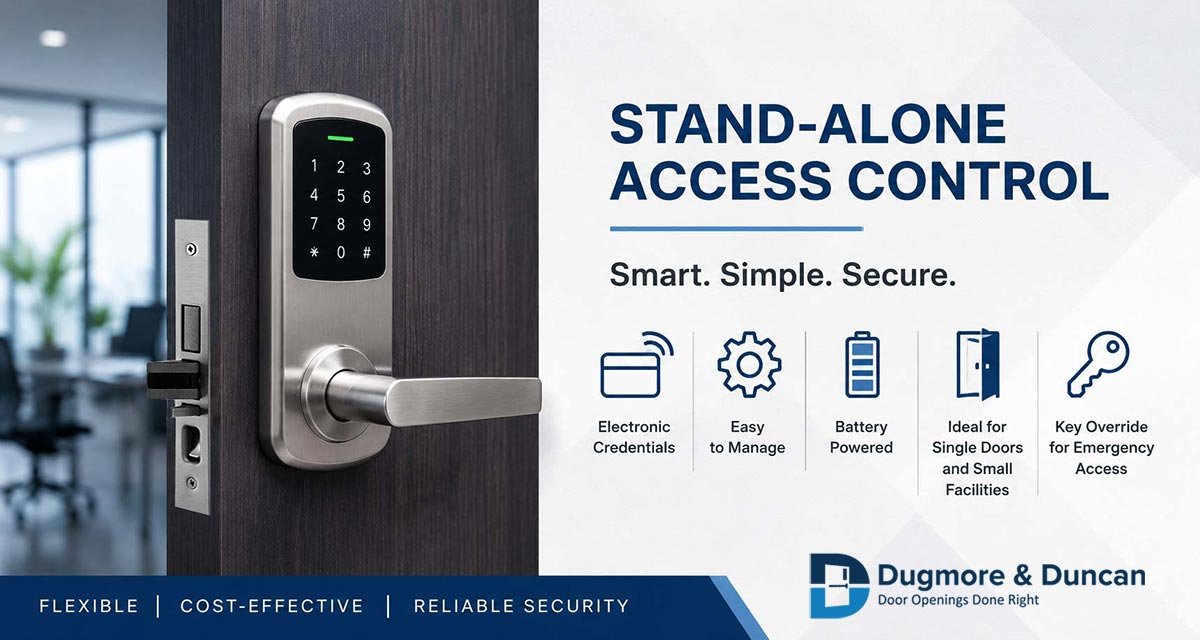
A Practical Introduction to Electronic Security for Modern Facilities.
As organizations continue modernizing their security infrastructure, many are looking for practical ways to improve access management without immediately investing in a fully networked enterprise access control system.
For commercial facilities, healthcare environments, government buildings, offices, multi-site organizations and retrofit projects, stand-alone electronic access control often serves as an effective entry point into electronic security.
At Dugmore & Duncan, we help organizations evaluate access control solutions based not only on security needs but also operational workflow, scalability, and long-term facility management goals.
Stand-alone access control systems provide many of the advantages of electronic credentials while maintaining a relatively simple and cost-effective deployment model.
What Is Stand-Alone Access Control?
Stand-alone access control refers to electronic locking systems that operate independently at the opening without requiring continuous communication to a centralized network or server.
Instead of relying solely on traditional mechanical credentials, these systems validate access electronically at the lock itself using:
PIN codes
Proximity cards
Fobs
Mobile credentials
Bluetooth-enabled devices
Common examples include:
Because each opening functions independently, stand-alone systems can often be installed quickly with minimal infrastructure requirements.
Why Organizations Are Adopting Stand-Alone Access Control
Many facilities are looking for ways to improve:
Access management
User accountability
Operational flexibility
Credential administration
After-hours security
Staff convenience
Stand-alone access control allows organizations to move beyond static physical access methods and toward more adaptable credential management.
Electronic credentials provide the ability to:
Add or remove users quickly
Create temporary credentials
Support changing schedules
Improve control over sensitive areas
Reduce administrative burden
For many facilities, this creates a meaningful improvement in day-to-day operations without the complexity of a fully networked enterprise system.
How Stand-Alone Systems Work
In a stand-alone environment, credential validation occurs directly at the opening.
When a user presents an approved credential, the lock determines whether access should be granted based on permissions stored locally within the device.
Because the system is self-contained:
No centralized control panel is required
No continuous network connection is necessary
Installation is often less disruptive
Infrastructure costs are reduced
Many systems also include a mechanical key override feature for emergency access or administrative override purposes.
In properly designed systems, the mechanical key system and electronic access control work together as complementary layers of security rather than competing technologies.
The Benefits of Integrating Mechanical and Electronic Access
One of the most practical advantages of stand-alone electronic locks is the ability to combine traditional mechanical hardware with modern electronic credential management.
This integrated approach provides operational flexibility while maintaining reliability and emergency accessibility.
Benefits of combining mechanical key override with electronic access control systems may include:
Electronic credential convenience for daily users
Mechanical override capability when necessary
Simplified transition from traditional locks
Compatibility with existing door hardware
Layered security strategy
Reduced disruption during upgrades
In many facilities, especially retrofit applications, integrating the mechanical key system into electronic access control creates a balanced and scalable security approach.
Where Stand-Alone Access Control Works Best
Stand-alone systems are often ideal for:
Small facilities
Individual office openings
Interior secure rooms
Administrative offices
IT closets
Staff-only areas
Storage rooms
Satellite buildings
Budget-conscious retrofit projects
Doors that won’t require user change and audit trail audits often
These systems are particularly useful where:
Running wire is difficult or expensive
Full enterprise access control is unnecessary
Fast deployment is desired
Existing openings need modernization
For many organizations, stand-alone systems provide a practical security upgrade without requiring a major infrastructure overhaul.
Operational Advantages of Stand-Alone Access Control
Simplified Installation
Stand-alone locks are typically easier to deploy than networked systems.
Many solutions:
Operate on battery power
Install similarly to traditional locksets
Require little or no wiring
Minimize construction disruption
This makes them highly attractive for occupied facilities and retrofit environments.
Flexible Credential Management
Electronic credentials allow organizations to adapt access permissions quickly as operational needs change.
Administrators can:
Issue temporary credentials
Manage contractors or visitors
Adjust schedules
Remove access when needed
Support rotating staff assignments
This flexibility is especially valuable in facilities where staffing, scheduling, and operational demands infrequently change.
Improved Operational Efficiency
Stand-alone systems can help reduce the administrative workload associated with managing physical access.
Electronic credential management often simplifies:
User onboarding
Access updates
Departmental access coordination
Temporary access assignments
This allows facilities personnel to spend less time managing openings and more time supporting operations.
Cost-Effective Modernization
For many organizations, stand-alone access control represents an affordable pathway into electronic security.
Compared to enterprise-level systems, these solutions often require:
Lower installation costs
Reduced infrastructure investment
Minimal network dependency
Faster deployment timelines
This makes them especially attractive for phased upgrades and smaller-scale projects.
Understanding the Limitations
While stand-alone access control offers significant benefits, it is important to understand its operational boundaries.
No Centralized Real-Time Management
Because each lock operates independently:
Credentials may need to be updated individually
Changes are not always system-wide
Administration becomes more complex as door counts increase
As facilities expand, centralized management often becomes more desirable.
Limited System Visibility
Many stand-alone systems provide limited audit and reporting functionality compared to enterprise access control platforms.
Organizations requiring:
Real-time monitoring
System-wide lockdown capability
Advanced reporting
Integrated surveillance
Multi-site credential management
…may eventually require a more advanced solution.
A Practical Step Toward Smarter Security
Stand-alone access control provides organizations with a manageable and effective way to modernize facility access management.
When properly implemented, these systems offer:
Improved operational flexibility
Better credential management
Simplified administration
Reduced infrastructure requirements
Faster deployment
Scalable modernization opportunities
Most importantly, they allow facilities to begin integrating electronic access control into their overall opening strategy without immediately committing to a fully networked enterprise system.
At Dugmore & Duncan, we help organizations evaluate not just the lock itself, but the complete opening, operational workflow, and long-term facility objectives behind the system.
Because successful access control is about more than securing a door — it’s about creating a practical, scalable, and manageable security environment that supports daily operations.
Partner with Dugmore & Duncan
Dugmore & Duncan specializes in complete door opening solutions for commercial, healthcare, government, institutional, and industrial facilities.
From stand-alone electronic locks to fully integrated enterprise access control systems, our team helps organizations evaluate:
Opening requirements
Credential management strategies
Mechanical and electronic integration
Retrofit opportunities
Scalability planning
Long-term operational goals
If your organization is evaluating stand-alone access control or planning future security upgrades, Dugmore & Duncan can help design a solution tailored to your facility and operational needs.