

By Brian Lundgren | Oct. 22, 2026
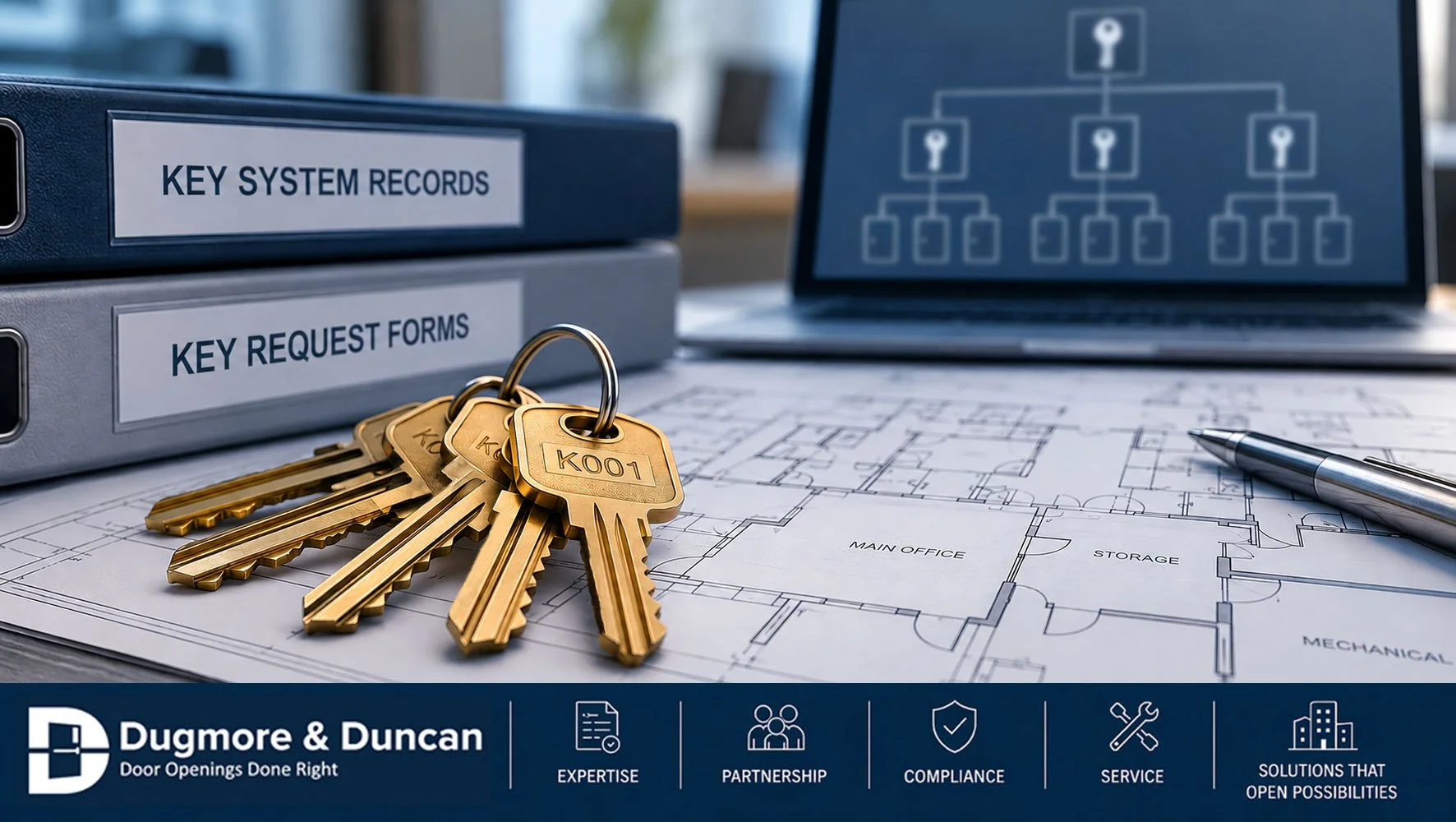
Do your key system records still match what is installed in your facility?
In our May Technically Speaking article, “Do You Know Where Your Keys Are?”, we discussed the importance of knowing who has access to your facility, controlling key issuance, recovering keys, and responding when keys are lost.
But knowing where your keys are is only part of maintaining effective key control.
There is another question worth asking:
Do your key system records still match what is installed in your facility?
When a master key system is first established, the relationship between keys, cylinders, doors, and access levels is carefully documented. But buildings don't remain static. Doors are added or replaced. Cylinders are rekeyed. Departments move. Renovations change access requirements. Buildings are expanded.
If those changes aren't documented as they happen, the system in the field can gradually drift away from the system on paper.
Your Key System Is a Living Document
A master key system shouldn't be treated as something that is designed once and then forgotten.
Accurate records should identify the keys and cylinders within the system and document how they relate to one another. When a cylinder is rekeyed, an opening is added, or access requirements change, the system documentation should change with it.
This becomes increasingly important in larger systems containing multiple levels of keying. A change involving one opening may affect more than a single keyholder or department.
Years later, facilities personnel shouldn't have to rely on institutional knowledge or trial and error to determine which keys operate which openings.
Give Every Key an Identity
Knowing that five copies of a particular key exist is useful. Knowing exactly which five keys exist is better.
ASSA ABLOY recommends individually identifying issued keys so each physical key can be tracked. This provides greater accountability and makes it easier to reconcile the keys in circulation with the system records.
Key markings should also avoid revealing unnecessary information. A key marked “MASTER” immediately tells someone what they have found. Blind coding allows an organization to identify a key without advertising its function or position within the hierarchy.
Document Changes When They Happen
One of the easiest ways for master key records to become inaccurate is to treat documentation as something that can be updated later.
Consider how easily changes accumulate:
A cylinder is replaced after a key is lost. A department moves to another floor. Several doors are rekeyed during a renovation. A new opening is added during construction.
Individually, these may be minor changes. Over several years, however, undocumented changes can create a master key system that looks very different from its original records.
Updating the documentation should therefore be part of the work itself—not a separate administrative task to be completed weeks or months later.
Don't Let Convenience Add Unnecessary Complexity
Changes to an established master key system should also consider the long-term structure of the system.
One example is cross-keying, where a cylinder is intentionally configured to operate with keys that would not normally fall within the same hierarchy. Cross-keying can solve a legitimate access requirement, but excessive use adds complexity and can reduce the combinations available for future expansion.
A change that makes access easier today shouldn't unnecessarily limit the system tomorrow.
Before modifying an established master key system, consider how the change affects the overall hierarchy, future expansion, and the ability to accurately maintain the system.
Protect the Records Like You Protect the Keys
Master key records are security information.
Depending on the system, those records may reveal which keys operate particular areas, how the hierarchy is structured, cylinder information, keyholders, and other details about how access is controlled throughout the facility.
Access to that information should be restricted.
Physical documentation should be securely stored, and electronic records should be appropriately protected and available only to authorized personnel. Detailed keying information should not simply reside in an unrestricted shared folder or spreadsheet.
Protecting the physical keys while leaving the information behind the system unsecured leaves an important part of the key-control program exposed.
Compare the Records to Reality
Even well-maintained documentation should occasionally be verified against the physical facility.
Choose a portion of the building and compare the records with what is actually installed. Does the cylinder at an opening match the documentation? Do the keys identified for that opening operate as expected? Have renovations, repairs, or departmental changes introduced anything that wasn't recorded?
The goal doesn't necessarily have to be a facility-wide inspection all at once. Periodically reviewing portions of the system can uncover discrepancies before they become widespread.
This is particularly valuable for facilities that have experienced years of renovations, expansions, rekeys, and personnel changes.
Does Your System on Paper Match Your System at the Door?
As we discussed in “Do You Know Where Your Keys Are?”, effective key control requires knowing who possesses your facility's keys and ensuring that access remains appropriate.
Maintaining the integrity of the master key system goes one step further.
Your keys, cylinders, hierarchy, and documentation should represent the facility as it exists today—not as it existed when the system was originally designed.
If your facility has undergone years of rekeys, renovations, expansions, or access changes, it may be worth asking a simple question:
If we compared our key records with the doors in our building today, would they match?
If the answer isn't clear, it may be time to review the system.
Dugmore & Duncan can help evaluate existing master key systems, identify discrepancies, review keying requirements, and develop a strategy for keeping your system accurate, secure, and manageable as your facility changes.