

By Brian Lundgren | Feb 20, 2026
A clear, concise guide to systems, technologies, and strategies that enable efficient, secure, and accessible entry solutions.
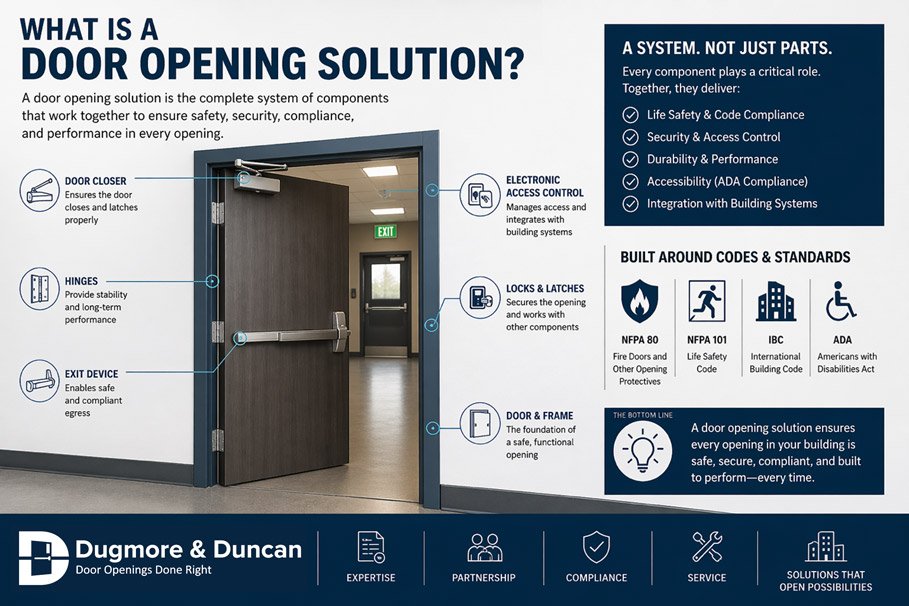
When most people think about a “door,” they picture a slab, a handle, and maybe a lock. In commercial environments, however, a door is not a standalone product—it’s part of a highly engineered system designed to ensure security, safety, compliance, and operational efficiency.
This is where the concept of a door opening solution comes in.
Defining a Door Opening Solution
A door opening solution refers to the complete assembly of components and systems that make a door function properly within a building. This includes not only the physical hardware, but also how each component works together to meet specific performance requirements.
A true door opening solution considers:
Life safety and code compliance
Security and access control
Durability and long-term performance
User accessibility (ADA compliance)
Integration with building systems
Rather than selecting parts individually, a door opening solution is engineered holistically to ensure everything works together seamlessly.
What Components Make Up a Door Opening?
A commercial door opening typically includes several integrated elements:
1. Door and Frame
Hollow metal, wood, or specialty doors
Fire-rated or non-rated assemblies
Frame construction and reinforcement
2. Mechanical Hardware
Locks, latches, and deadbolts
Hinges, pivots, and continuous hinges
Door closers and exit devices (panic hardware)
Pulls, pushes, and protection plates
3. Electronic Access Control
Card readers, keypads, or biometric devices
Electrified locks and strikes
Door position switches and request-to-exit devices
Integration with security systems and software
4. Life Safety Components
Fire-rated hardware and doors
Emergency egress systems
Smoke seals and gasketing
Automatic door operators for accessibility
5. Key Systems and Credential Management
Master key systems
Restricted keyways
Credential hierarchy for secure access control
Each component must be selected and configured to work together—this is what separates a solution from a simple parts list.
Why Door Opening Solutions Matter
In commercial and institutional facilities—such as schools, hospitals, and government buildings—doors are critical control points. Poorly specified or mismatched hardware can lead to:
Security vulnerabilities
Code violations and failed inspections
Premature hardware failure
Operational inefficiencies
Increased maintenance costs
A properly designed door opening solution ensures:
Safe and compliant egress in emergencies
Controlled access to sensitive areas
Consistent performance across high-traffic environments
Long-term cost savings through durability and standardization
The Role of Codes and Standards
Door opening solutions must comply with a range of building and life safety codes, including:
NFPA 80 (Fire Doors and Other Opening Protectives)
NFPA 101 (Life Safety Code)
IBC (International Building Code)
ADA (Americans with Disabilities Act)
These codes dictate how doors must function in real-world scenarios—especially during emergencies. For example:
Exit doors must allow unobstructed egress
Fire-rated doors must self-close and latch properly
Accessible doors must require minimal opening force
A door opening solution ensures all these requirements are met simultaneously.
Door Openings as a System, Not a Product
One of the most common mistakes in commercial construction and facility management is treating door hardware as a commodity purchase.
In reality, door openings should be approached as systems engineering challenges. Every decision—down to the hinge type or closer strength—affects:
Door alignment and longevity
User experience
Security effectiveness
Code compliance
This is especially critical in high-demand environments like:
K–12 schools and universities
Healthcare facilities
Government and municipal buildings
Commercial and industrial facilities
The Value of a Professional Door Hardware Partner
Designing and implementing a door opening solution requires technical expertise, coordination, and real-world experience.
A professional partner provides:
Specification and submittal support
Code compliance guidance
Master key system design
Access control integration
Installation and field coordination
Ongoing service and maintenance
This ensures consistency across all openings and reduces risk throughout the lifecycle of the building.
Final Thoughts
A door may seem simple—but in commercial environments, it’s one of the most critical components of a building’s infrastructure.
A door opening solution goes beyond hardware. It’s a strategic approach to safety, security, and performance—ensuring every opening functions exactly as intended, every time.